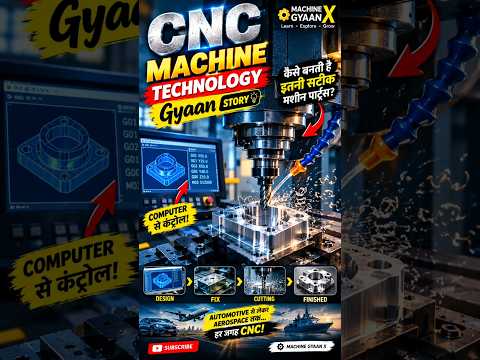
Have you ever wondered how complex metal components, intricate custom parts, or delicate mechanical devices are created with absolute perfection? The secret lies in Computer Numerical Control (CNC) technology, a fundamental pillar of modern automated machinery.
From aerospace engineering to medical equipment, CNC machines have revolutionized how raw materials are cut, shaped, and fabricated. But how do these advanced systems actually work? Let’s break down the mechanics behind CNC technology and why it shapes today's manufacturing landscape.
What is a CNC Machine and How Does It Work?
CNC stands for Computer Numerical Control. Unlike traditional manual tools that rely on hand wheels and levers, a CNC machine is guided entirely by pre-programmed computer software.
The fabrication process begins with a 3D model created using Computer-Aided Design (CAD) software. This digital design is translated into G-code—a standardized machine language that delivers explicit instructions to the equipment. The G-code directs the cutting tool’s coordinates, movement speed, rotational velocity, and depth of cut.
Once the operator loads the program and secures the material, the equipment carries out the entire process autonomously, turning raw metal, wood, or plastic into a finished product.
The Role of Automated Machinery in Modern Manufacturing
The integration of advanced automated machinery has completely reshaped industrial production lines. By combining microchip computing power with heavy mechanical force, CNC machines eliminate manual labor constraints and dramatically lower the risk of human error.
In modern factories, automated systems perform tasks like milling, turning, routing, and laser cutting continuously. This round-the-clock capability dramatically reduces material waste, speeds up turnaround times, and ensures every single piece produced is identical to the first.
Key Benefits of CNC Technology
CNC automation delivers several critical advantages across industries:
- Micro-Level Precision: CNC systems operate with extreme tolerances, making them perfect for high-precision components like turbine blades or surgical tools.
- Scalable Production: Whether producing a single custom prototype or thousands of identical parts, the software ensures flawless repeatability.
- Enhanced Workplace Safety: Operators control and monitor the machinery through digital interfaces, staying safely away from high-speed cutting zones.
As consumer demand for custom products and ultra-fast manufacturing increases, next-generation automated machinery driven by CNC controls will remain at the forefront of industrial innovation.