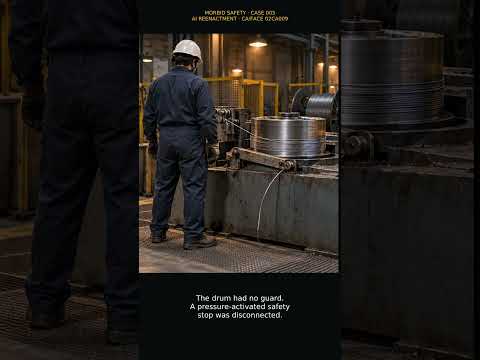
In manufacturing and industrial environments, heavy machinery operates with massive power and speed. When safety precautions are overlooked, the consequences can be immediate and fatal. A sobering case documented by California FACE (Case 02CA009) serves as a stark reminder of what happens when safety protocols fail. A worker lost their life while operating a wire-drawing machine—a tragedy caused by a dangerous combination of an unguarded spinning drum and a disconnected safety stop switch.
A Preventable Industrial Tragedy
The incident occurred during routine operations involving a high-speed wire-drawing machine. As the heavy drum spun, the operator was exposed to severe mechanical hazards. Tragically, the physical barrier designed to protect the worker was missing, and the emergency safety stop had been disabled. Without these crucial protections, the worker was drawn into the rotating equipment, resulting in a fatal injury.
Case studies like this highlight a recurring theme in industrial accidents: most workplace injuries and fatalities are entirely preventable. When safety devices are bypassed or removed for convenience, the risk of catastrophic entanglement increases exponentially.
Why Proper Machine Guarding Is Non-Negotiable
Implementing robust machine guarding solutions is one of the most effective ways to protect operators from moving parts, nip points, and rotating shafts. Physical barriers act as a vital line of defense between the worker and dangerous mechanical components, preventing accidental contact.
Effective machine guarding goes beyond simple physical covers. It encompasses integrated safety systems, including safety interlocks, presence-sensing devices, and easily accessible emergency stop mechanisms that automatically shut down machinery if a hazard zone is breached. Disabling or failing to maintain these systems completely defeats their purpose and places workers in direct harm's way. Regulatory standards strictly require that all hazardous machinery parts remain properly guarded during operation.
Key Takeaways for Workplace Safety
To prevent similar tragedies, facilities must enforce strict safety protocols across all operations:
- Conduct Regular Inspections: Inspect all equipment daily to ensure physical guards are securely installed and functional.
- Enforce Safety Device Integrity: Never allow safety switches to be bypassed or emergency stops to be disconnected.
- Implement Lockout/Tagout Procedures: Ensure machinery is completely de-energized and zero-energy state is verified before maintenance or adjustments.
- Provide Comprehensive Operator Training: Educate workers on the specific mechanical hazards of their equipment and the vital necessity of safety barriers.
Ultimately, prioritizing machine guarding is not merely a matter of regulatory compliance—it is a fundamental responsibility to ensure every worker returns home safely at the end of their shift.