The Future of Energy: How Machine Learning in Manufacturing is Revolutionizing Solid-State Batteries
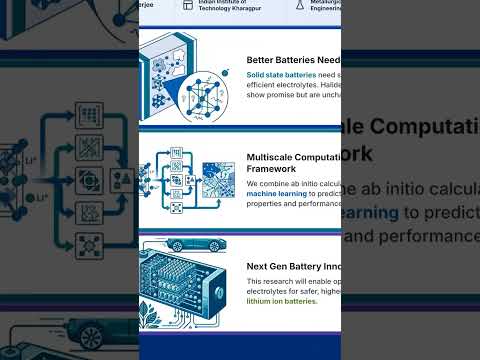
Imagine a world where your smartphone charges in seconds, and your electric vehicle can travel hundreds of miles after just a five-minute plug-in. This isn't a scene from a science fiction movie; it is the burgeoning reality of energy storage. At the forefront of this revolution is Dr. Sankha Mukherjee and his pioneering team, who are leveraging cutting-edge technology to design the next generation of super-fast solid-state batteries.
The Shift to Solid-State Technology
Traditional lithium-ion batteries, while revolutionary, have hit a performance ceiling. They rely on liquid electrolytes that can be volatile, prone to leaking, and limited in energy density. Solid-state batteries are the long-awaited successor, replacing these liquids with solid materials to ensure higher safety standards and significantly faster charging capabilities. However, discovering the perfect combination of materials to make these batteries commercially viable has historically taken decades of trial and error.
Accelerating Innovation Through Machine Learning
This is where the paradigm shift occurs. By implementing machine learning in manufacturing and design phases, Dr. Mukherjee’s team can bypass the slow, traditional methods of material discovery. Instead of testing thousands of physical prototypes, researchers use advanced algorithms to simulate and predict how different solid electrolytes will perform under real-world conditions.
The integration of machine learning in manufacturing allows for the rapid identification of stable chemical compositions that offer high ionic conductivity. This data-driven approach doesn't just speed up the research process; it optimizes the precision of the final product, ensuring that the batteries produced are more durable and efficient than anything currently on the market.
Impact on the Global Energy Landscape
The implications of this research, supported by initiatives like ANRF PRISM, are staggering. Beyond consumer electronics, these AI-designed batteries could be the key to widespread EV adoption by solving "range anxiety" once and for all. Furthermore, as we transition to renewable energy, high-capacity solid-state storage will be essential for stabilizing power grids that rely on solar and wind energy.
The work being done today proves that the synergy between AI and industrial science is the ultimate catalyst for change. As we refine the application of machine learning in manufacturing, we aren't just making better batteries—we are building the foundation for a safer, faster, and more sustainable future.