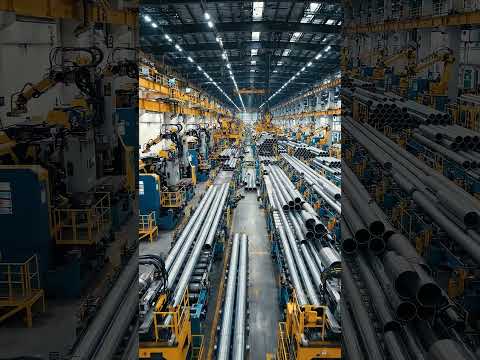
There is something undeniably hypnotic about watching raw materials transform into finished products. In the high-stakes world of industrial manufacturing, few processes are as visually captivating as the creation of steel pipes. From the moment a massive coil of raw metal begins its journey through heavy-duty rollers to the final high-pressure quality checks, every second is a testament to the harmony of human engineering and automated precision.
From Flat Sheets to Cylindrical Perfection
The journey begins with massive coils of raw steel, known as "skelps." These are unrolled and fed into a series of forming rollers that exert immense pressure. This is where the magic of industrial manufacturing truly shines. As the metal moves through the assembly line, the rollers gradually curve the flat edges toward each other. In a seamless motion, what was once a flat sheet of rigid steel becomes a perfectly shaped hollow cylinder.
The Science of Joining and Welding
Once the cylindrical shape is formed, the edges must be joined. Depending on the specific requirements of the pipe, this is usually achieved through High-Frequency Induction (HFI) welding. A massive amount of heat is concentrated at the seam, fusing the metal together instantly without the need for additional filler material. Watching the sparks fly as the seam disappears into a smooth, solid bond is both satisfying and incredibly efficient.
Finishing Touches and Quality Control
After the welding is complete, the pipe undergoes a "sizing" process to ensure it meets exact diameter specifications. It is then cooled, straightened, and cut to specific lengths by high-speed automated saws. This level of consistency is a hallmark of modern industrial manufacturing, ensuring that every pipe—whether it is destined for a massive oil pipeline or a structural building frame—meets rigorous safety and durability standards.
The result is more than just a piece of hardware; it is a masterpiece of precision. Seeing these giant machines work in perfect synchronization reminds us how far technology has come in turning raw earth into the literal backbone of our modern infrastructure.