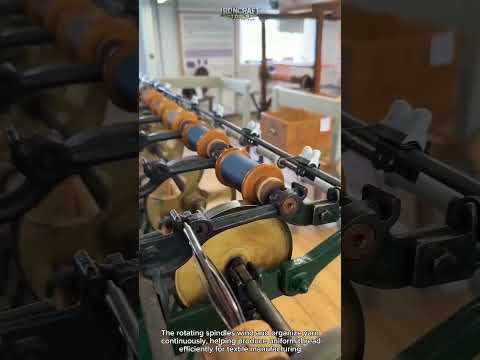
Have you ever stopped to wonder how thousands of meters of smooth, durable yarn are produced in a matter of minutes? Behind every piece of clothing, upholstery, and fabric we use daily lies a masterpiece of modern engineering. The modern textile industry relies heavily on specialized industrial machinery to transform loose raw fibers into the continuous strands of yarn required for global manufacturing.
From Raw Fiber to Thread: The Core Spinning Process
The process of turning raw, unspun fibers into fine thread is both a science and an art. In modern factories, automated spinning systems work continuously to execute three key operations: drawing, twisting, and winding.
First, raw fibers—whether natural like cotton and wool, or synthetic like polyester—are cleaned, carded, and drawn out into thin strands. Next, the spinning mechanism applies precise mechanical tension and high-speed twisting to lock the fibers together. This twisting action gives the yarn its structural strength and elasticity. Finally, the finished yarn is wound tightly onto bobbins or cones, ready for weaving or knitting.
High-Speed Efficiency in Modern Textile Machinery
What makes today's yarn-spinning systems so remarkable is their staggering speed and precision. Traditional spinning methods took hours to produce a single spool of thread. In contrast, advanced textile machinery operates at thousands of revolutions per minute (RPM), running around the clock with minimal human intervention.
Sensory feedback loops and computerized control panels monitor fiber thickness, tension, and potential breakages in real time. If a strand snaps, automated sensors instantly adjust the operation or signal technicians, ensuring uniform quality and drastically reducing material waste.
Fueling the Global Textile Supply Chain
As global demand for apparel and technical textiles continues to grow, manufacturing plants must balance speed with uncompromised quality. Utilizing state-of-the-art machinery allows textile manufacturers to scale their output efficiently while maintaining the strict standards required by fashion brands and industrial consumers alike.
Ultimately, the continuous evolution of yarn spinning technology highlights the vital role of engineering in everyday life. The next time you put on a cotton shirt, you are experiencing the direct result of modern mechanical innovation at work.