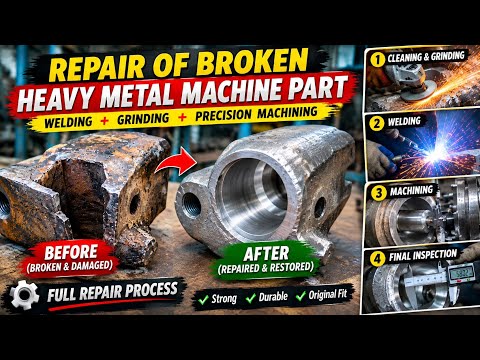
In heavy industrial operations, equipment downtime can lead to significant financial losses and delayed production schedules. When a critical heavy-duty part snaps or wears down under extreme stress, waiting weeks for an original manufacturer replacement is not always practical. Fortunately, advanced metalworking techniques—combining heavy welding, surface grinding, and precision machining—can completely restore damaged industrial equipment. In this article, we break down the step-by-step process of inspecting, rebuilding, and refinishing a heavy-duty machine component back to factory specifications.
Step 1: Structural Assessment and Preparation
The restoration journey always begins with a detailed damage assessment. Micro-fractures and stress points must be identified before applying heat or pressure. Technicians clean the damaged section thoroughly, stripping away grease, rust, and surface contaminants. To prepare for welding, a deep bevel groove is ground along the crack line. This ensures maximum weld penetration and structural integrity throughout the core of the broken metal.
Step 2: High-Strength Welding and Stress Relief
Once prepared, high-strength welding techniques are employed to fuse the fractured sections together. Using specialized filler alloys that match the original metallurgy, molten metal is deposited layer by layer. Proper temperature control during this phase prevents thermal warping and internal stresses. This critical step rebuilds the lost material, ensuring the restored machine component can withstand intense torque, vibration, and heavy workload conditions once reinstalled.
Step 3: Precision Machining and Surface Grinding
Welding restores strength, but it leaves behind rough, uneven surfaces. The part is transferred to precision industrial machinery, such as heavy-duty lathes and milling equipment. Technicians precisely machine away the excess weld material to achieve exact dimensional tolerances. Finally, high-precision grinding is applied to achieve a mirror-like finish and restore smooth bearing fits or mating surfaces down to the millimeter.
Final Quality Assurance
Before returning to active duty, the refinished part undergoes rigorous dimensional checks and stress inspections. Repairing and refinishing an existing machine component not only cuts down machinery downtime drastically, but it also delivers massive cost savings compared to purchasing brand-new replacement parts. With skilled craftsmanship and modern tools, even severely damaged heavy machinery parts can operate reliably for years to come.