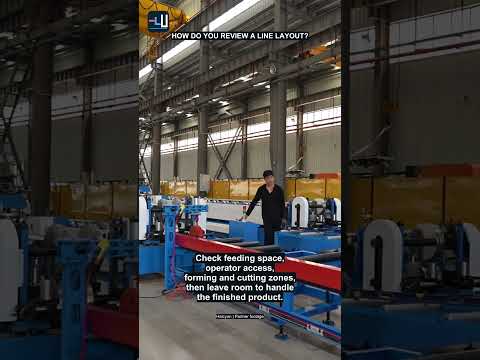
Investing in a new roll forming system is a significant milestone for any manufacturing facility. However, the success of your investment depends heavily on how well you review the initial equipment layout. A well-thought-out design ensures that your workflow remains fluid, reducing downtime and maximizing the benefits of modern production line automation.
If you are a buyer or a plant manager, here is a step-by-step guide on how to effectively review a roll forming line layout before the first piece of equipment is even installed.
Follow the Material Path
The most effective way to analyze a layout is to "walk" the material path from start to finish. Begin at the entry point—the decoiler and feeding system—and trace the metal through every stage: leveling, punching, roll forming, and cutting. By visualizing the flow, you can identify potential bottlenecks or areas where the material might be difficult to manage. Ensuring a linear and logical progression is the first step toward achieving seamless production line automation.
Consider Space and Accessibility
A common mistake is focusing only on the machines while ignoring the space around them. During your review, check for: * Maintenance Access: Is there enough room for technicians to reach critical components? * Operator Safety: Are the walkways clear, and is there enough space for the operator to monitor the controls safely? * Material Handling: Is there sufficient clearance for forklifts or cranes to load heavy coils and remove finished bundles?
Optimizing for Throughput
The layout must account for the speed and volume of your specific production goals. When reviewing the blueprint, look at the transition points between different stations. If your goal is to reduce manual labor, the layout should be optimized for a high level of production line automation, incorporating features like automatic stacking, wrapping, or palletizing systems at the end of the line.
Final Review Checklist
Before giving the final approval, ask yourself: Does this layout minimize material travel distance? Does it fit within the physical constraints of my factory floor? And most importantly, does it allow for future scalability?
By taking the time to meticulously review your roll forming line layout, you aren't just buying machinery—you are designing a high-performance environment that will drive your company’s productivity for years to come.