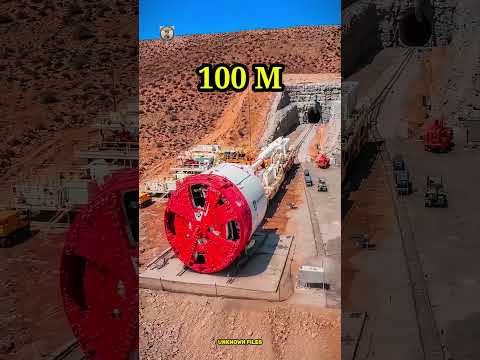
Imagine spending hundreds of millions of dollars on a state-of-the-art machine, only to leave it buried forever once the job is finished. It sounds like a financial nightmare, but in the world of mega-engineering, abandoning giant Tunnel Boring Machines (TBMs) deep beneath the earth is a surprisingly practical strategy.
So, why would contractors permanently entomb these engineering marvels beneath our cities?
The Giants of Underground Construction
Tunnel Boring Machines are among the largest and most expensive industrial equipment ever created. Weighing thousands of tons and stretching longer than a football field, these mechanical beasts can cost up to ₹700 crore ($80+ million) each. They chew through solid bedrock, mud, and soil to build subway lines, highway passages, and water utility networks.
However, once a TBM reaches the end of its subterranean journey, engineers face a major dilemma: how do you get it out?
Why Retrieval Isn't Always an Option
When a tunnel is finished, extracting such massive industrial equipment is a logistical nightmare. Retrieving a TBM requires digging a colossal exit shaft from the surface or meticulously dismantling the machine piece by piece in a confined space. In crowded urban areas or deep mountainous regions, digging an extraction site is often physically impossible or astronomically expensive.
In many cases, the labor, risk, and infrastructure costs required to retrieve the machine far exceed its remaining resale value.
Tailor-Made and Single-Use
Another key factor is customization. TBMs are rarely off-the-shelf products; they are custom-built for specific soil conditions, rock densities, and tunnel diameters. Because the cutting head and structural shell suffer extreme wear and tear during operation, they cannot easily be reused on a different project.
Before burying the machine, workers usually salvage the high-value components, such as electric motors, hydraulic systems, and control electronics. The outer steel shell and cutter frame are then driven into a side pocket, sealed off, and encased in concrete.
A Calculated Engineering Decision
While leaving top-tier industrial equipment underground seems wasteful at first glance, it is ultimately a calculated financial and structural choice. Leaving the heavy steel shell buried helps reinforce the surrounding earth, saving construction teams time, safety risks, and millions of dollars in unnecessary retrieval efforts.